For nearly twenty years, the Avast Porthole has had one simple job: to give reefkeepers a clear, top-down view of their aquariums.
That original tube worked well. It helped hobbyists, coral farmers, and photographers cut through surface glare, water ripples, and awkward shooting angles. It was simple and durable, solving a problem every reefer eventually encounters.
However, over the last twenty years, its use has changed entirely.
Our customers began sending us photos and videos that far exceeded our initial expectations. They used the product for commercial livestock sales, daily growth monitoring, social media reels, and professional macro photography. Meanwhile, smartphones became the primary camera for most hobbyists, driving strong demand for a faster, more streamlined way to capture clear shots.
We were hitting the same walls ourselves. The more we used the original Porthole in our own shop for daily reefkeeping and social media, the clearer it became that a cosmetic redesign would not cut it. We needed to rebuild the entire system around how reefkeepers shoot today.
Evolving to meet reefer's needs
The core principle of the original Porthole did not need reinvention. Placing an optical window below the water's surface remains the best way to eliminate reflections and surface distortion.
What needed to change was everything around that window. When we first built the Porthole, serious reef imaging required a dedicated DSLR camera.
Today, much of the most critical tank documentation happens on smartphones. You spot a rare coral with extreme polyp extension, a potential pest, a spawning event, or a frag that needs to go up for sale, and your phone comes out of your pocket immediately.
A smartphone camera does not need the same interface as a heavy DSLR. It needs instant alignment, a clean mounting method, a way to block overhead glare, and a form factor that does not turn a quick photo into a massive production.
Meanwhile, our DSLR and mirrorless users were asking for more robustness. They needed better lens clearance, tighter control of internal stray light, a rock-solid connection, and a way to make the Porthole feel like an integrated extension of their lens rather than a separate box they had to awkwardly hold in place.
Those two distinct workflows pushed our design team in two different directions. The Mark II architecture was built to solve both.
Rebuilt From Real Shop Experience
Every upgrade to the Mark II system came from real-world frustration.
The Creator Mobile Cradle (made for the iPhone at the time of this release) came from watching reefkeepers fumble with universal phone clamps around the water. We knew the mount had to be fast and predictable. By designing the cradle around the MagSafe ecosystem, your phone now snaps into perfectly centered alignment instantly. You attach the phone, place the Porthole in the water, and take the shot.
We also integrated a custom internal light shield into the cradle to eliminate the dreaded overhead LED wash and lens reflection. Anyone who has tried to take a top-down photo knows that overhead aquarium lights reflect directly into the phone lens, washing out color and destroying contrast. The light shield completely blocks ambient glare from hitting the lens.
For the optics, we did not simply make the tube bigger or smaller. We refined the internal light path to a precise 90mm diameter to perfectly match the profiles of modern lenses. This geometry eliminates internal light bounce and maximizes color saturation.
Real Filters for Real Colors
One of the most practical upgrades to the Creator system is the addition of a bonded aluminum 52mm internal filter thread.
Reef lighting looks incredible to the human eye, but completely confuses camera sensors. We wanted to eliminate the terrible blue wash in smartphone photos without forcing people to rely on clumsy clip-ons or heavy digital editing.
By using a standard 52mm photography thread, you can now drop a true 16,000k color-correction filter, a neutral-density filter, or a polarizer directly into the dry chamber. You get true-to-life color saturation directly on your phone's sensor before you ever hit the record button.
Moving From a Tool to an Ecosystem
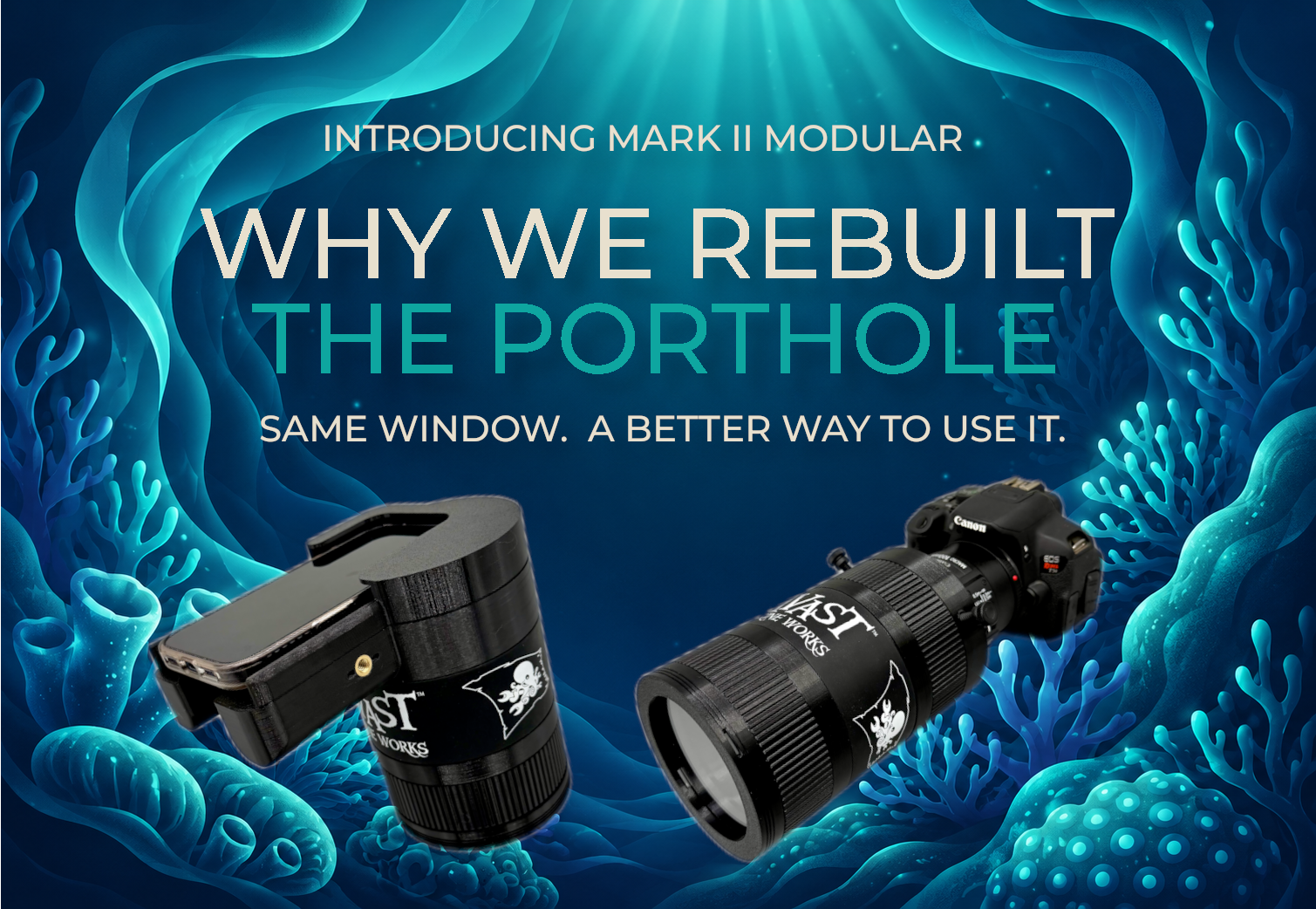
The real breakthrough of the Avast Marine Porthole Mark II generation is that it is no longer just a standalone product. It is a fully unified, modular ecosystem centered around our heavy-duty 100mm threading.
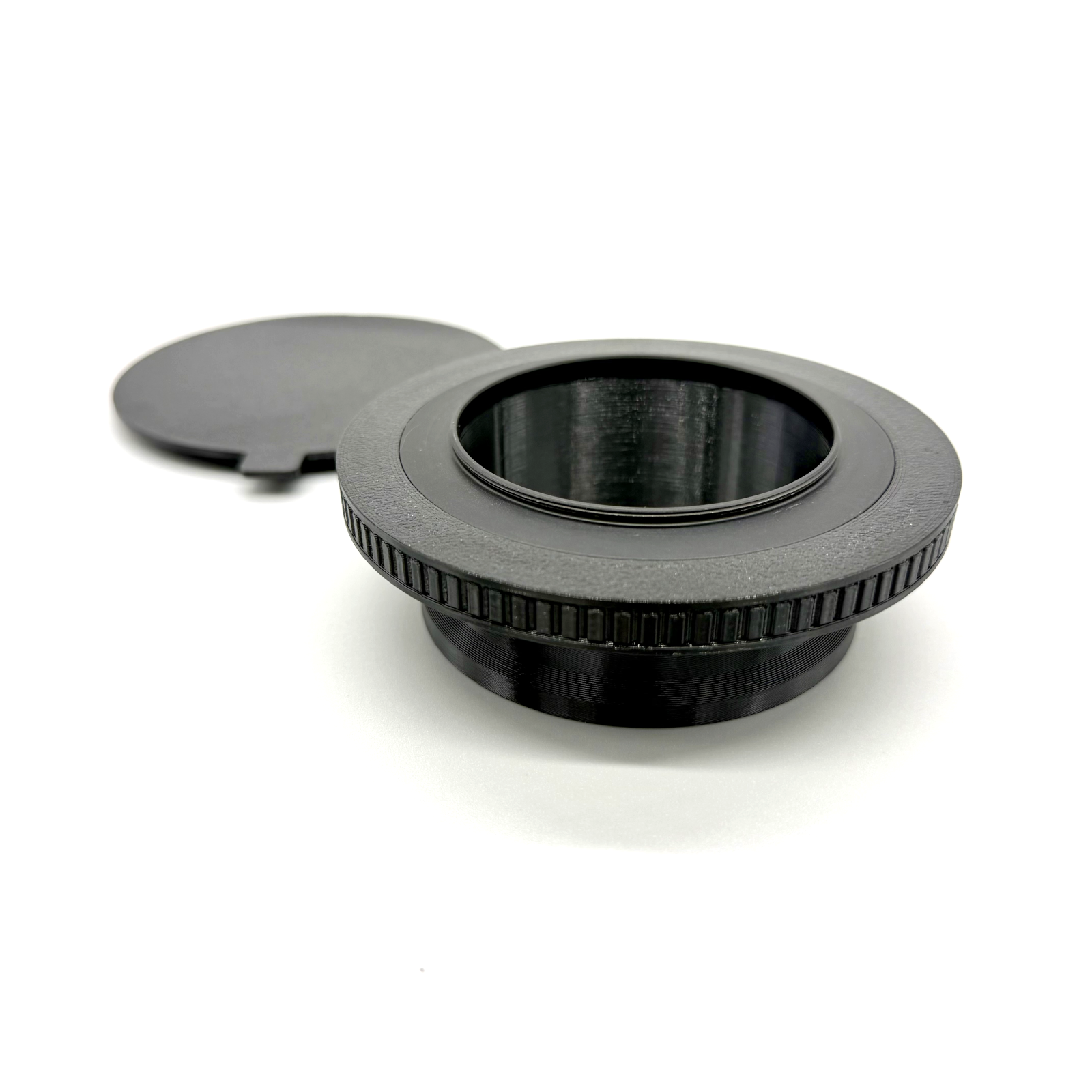
The Lower Lens Assembly is the shared wet side foundation. From there, you build the setup that matches your specific workflow.
-
Porthole Studio: Built for DSLR and mirrorless users who need a stable, controlled platform. It features axial soft nylon thumbscrews with embedded hex nuts for a non-slip grip that will not scratch your lens barrel. It provides the rigidity required for high-resolution macro capture.
.png)
-
Porthole Creator: Built for the mobile workflow. It gives you the MagSafe alignment cradle, the 52mm filter integration, and built-in rigging points for handles or tripods. It even works as a dual-purpose tool. You can unscrew the lower lens assembly and use the cradle directly against your front tank glass to shoot head-on while completely eliminating room reflections and blue wash.
.png)
- MIIM Prime Interface: Built for dedicated macro shooters. It bypasses universal clamps and threads directly onto the front of your lens, creating a perfect 12-inch sensor-to-acrylic distance. This unique engineering leaves your manual focus and zoom rings completely accessible for critical macro adjustments.
The Next Generation of Reef Imaging
We can now achieve this thanks to the evolution of our manufacturing capabilities. Modern techniques enable us to produce highly complex, precise internal geometries and tighter modular connections that were impossible two decades ago.
The heart of the Porthole remains exactly the same. It is still a premium window designed to help you see and document your aquarium without water getting in the way. But the system built around that window is entirely new.
Whether you are tracking long-term coral growth for husbandry diagnostics, filming social content, or capturing publication-grade macro shots, the Avast Marine Porthole Mark II family is built for how you shoot.
This Is Just the Beginning
As the Avast Marine Porthole Mark II system rolls out, reef photography will become a much bigger focus for us.
That means more practical education on phone settings, filter use, shooting angles, macro setup, video workflows, and simple ways to get better photos without turning your tank into a studio.
It also means sharing more of what reefkeepers are creating with the system: customer photos, behind-the-scenes examples, social media features, Reef2Reef Photo of the Month content, and real-world shooting notes from tanks that use it.
The next step is not just building better tools; it is helping reefkeepers use them.