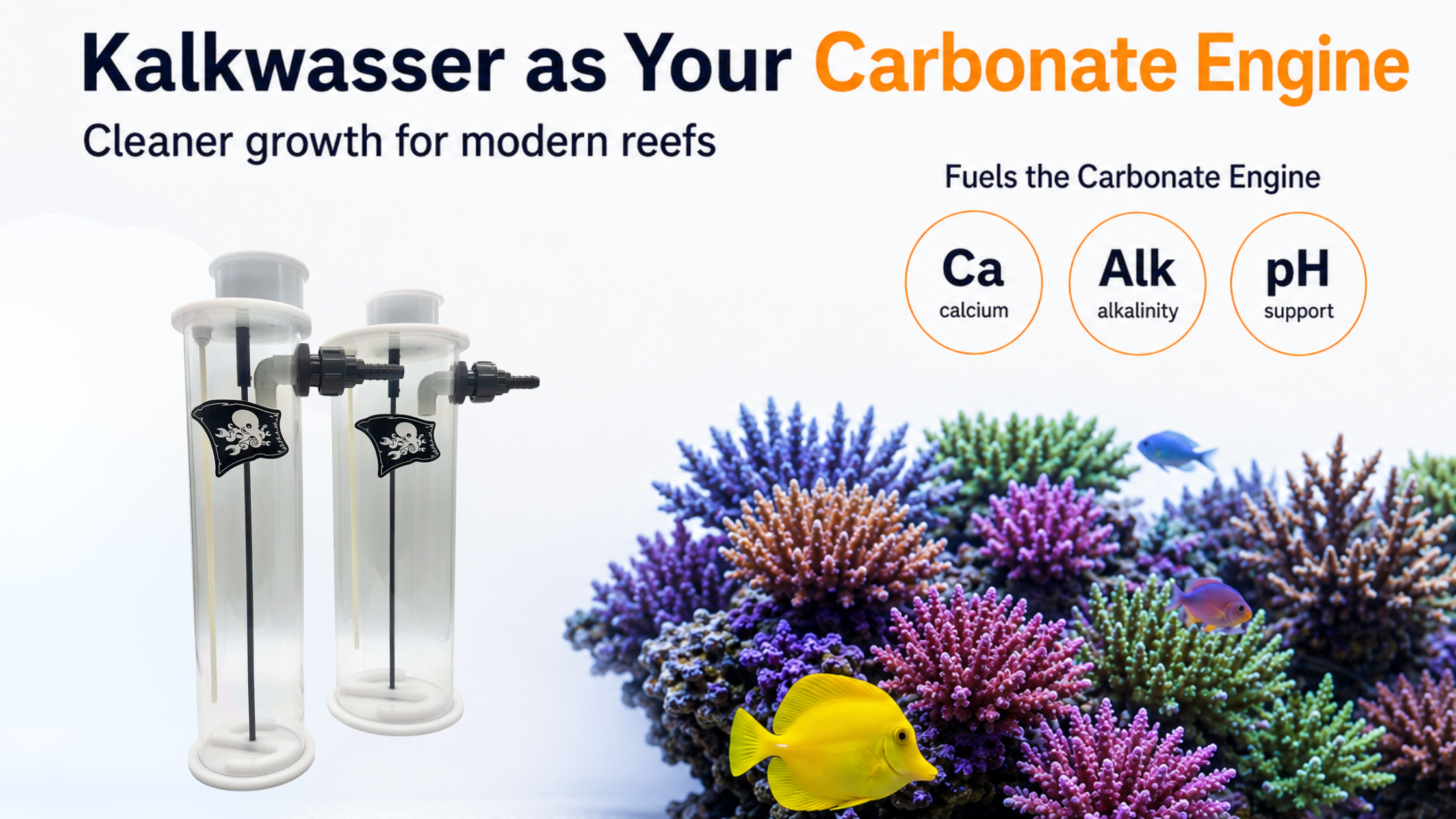
Kalkwasser is often viewed as a legacy method, but it remains one of the cleanest and most effective ways to power a modern reef. Rather than just "chasing numbers," Kalkwasser supports the carbonate engine (the linked chemistry of calcium, alkalinity, and pH) without the ionic buildup associated with other dosing methods.
- Cleaner Growth: Kalkwasser is "ionically quiet," adding calcium and alkalinity without increasing sodium chloride levels over time.
- pH Support: By neutralizing CO₂, it creates a more favorable environment for rapid coral calcification.
- The Reactor Advantage: A proper stirrer allows you to dose a clear, saturated effluent while containing the chemically aggressive slurry.
The Bottom Line: Use Kalkwasser as your primary baseline for calcium and alkalinity. It simplifies your chemistry, stabilizes your pH, and allows for cleaner, more sustainable reef growth.
A question we often get asked
“I know kalkwasser helps maintain calcium, alkalinity, and pH, but is it still worth using on a modern reef tank with so many dosing options available?”
Excellent question. Kalkwasser has been part of reefkeeping for decades, so it is easy to treat it as an old method that has survived mostly by habit. That undersells what it actually does. Kalkwasser remains one of the cleanest ways to support a growing reef, especially when the goal is not only to maintain calcium and alkalinity levels but also to maintain the carbonate chemistry that supports skeletal growth.
A reef tank is a closed system. Calcium and alkalinity are consumed every day by corals, coralline algae, clams, and other calcifying organisms. In a mature reef, that consumption is not incidental. It is structural. Every new coral branch, every encrusting edge, every patch of coralline algae, and every shell layer represents chemistry becoming reef mass.
That process is the carbonate engine.
Kalkwasser is one of the simplest ways to keep that engine running.
The Carbonate Engine
In reefkeeping, calcium and alkalinity are often treated as two separate test results. In the tank, they are part of the same growth pathway.
Calcifying organisms use calcium and carbonate chemistry to build a calcium carbonate skeleton. Reefkeepers usually first see this demand in alkalinity consumption. A growing reef may test stable for a while, then begin pulling alkalinity down faster as coral mass increases. That is not a random shift; it is the reef accelerating.
Kalkwasser, or limewater, is calcium hydroxide dissolved in freshwater. When it enters seawater, it contributes calcium and hydroxide. The calcium supports skeletal formation. The hydroxide enters the carbonate system, supporting alkalinity and helping neutralize some of the carbon dioxide pressure that often suppresses pH in indoor aquariums.
The result is not just the addition of calcium. It is carbonate support.
That distinction matters. A reef does not grow from isolated numbers. It grows from chemistry, moving through a system at the right rate, in the right form, with the least unnecessary baggage.

pH Is Not Just a Graph
pH is easy to oversimplify. Some reefkeepers chase it. Others ignore it. Neither approach is ideal; pH is part of the carbonate environment surrounding coral tissue. Many modern homes have elevated indoor carbon dioxide levels, especially when windows are closed, HVAC systems are efficient, and occupancy is high. That carbon dioxide dissolves into aquarium water, shifting the carbonate system toward lower pH.
A reef can survive at a lower pH. Many do. The more useful question is whether the system is working harder than it needs to. Kalkwasser helps by adding alkalinity in a high-pH form. It does not simply raise a number on a controller. It helps counter some of the acidifying pressure created by carbon dioxide. When applied steadily and responsibly, Kalkwasser can move the tank toward a more favorable carbonate environment for calcification. The keyword is responsibly.
Kalkwasser is powerful. It should be dosed slowly, based on measured evaporation and alkalinity demand. pH improvement is one of its benefits, but pH should not be the only control point. Alkalinity still tells the more important story.
Ionic Balance and Cleaner Growth
Two-part dosing works. Calcium reactors work. Many beautiful reefs use both. Kalkwasser has a different advantage. It is ionically quiet.
Many two-part systems add calcium and alkalinity using calcium chloride and sources of sodium carbonate or bicarbonate. Those additions can leave sodium and chloride behind over time. Randy Holmes-Farley has written that adding 1 dKH of alkalinity per day, with balanced calcium addition, can add sodium and chloride, resulting in an estimated 0.63 ppt salinity increase per month before correction.
That does not make two-part wrong. It does mean heavy two-part use is not chemically invisible.
Kalkwasser adds calcium and alkalinity without introducing the same sodium chloride residue. In a growing reef, Kalkwasser is especially valuable as the baseline method. Let Kalkwasser carry as much of the daily calcium and alkalinity demand as evaporation safely allows. Use two-part, a calcium reactor, or another method for the remaining demand if the reef outgrows Kalkwasser alone. That is the cleaner growth strategy. Kalkwasser first. Complexity only where the reef actually requires it.
Purity Matters. Behavior Matters More Than Most People Think.
Calcium hydroxide is not just a powder once it enters a Kalk stirrer. It becomes a working slurry.
That slurry has to hydrate, suspend, settle, and remain usable over time. It has to remain saturated without forming a hard mass at the bottom of the reactor. It has to support clear effluent rather than push solids into the aquarium. This is where product choice matters.
We started using Mississippi Lime in 2008 and designed our stirrers around its performance and mixing characteristics. After more than a year of bench testing many branded Kalkwasser products, we concluded that no other calcium hydroxide is better for our stirrers. It maintains a consistently high pH, calcium, and alkalinity saturation, mixes easily, reliably delivers clear saturated effluent, and forms a non-clumping slurry at the bottom of the stirrer.
That last point is not a detail. It is the system.
Some pharma-style Kalk products are very high in purity, but that does not automatically make them the best choice for every reactor. We have tested high-quality Kalk that did not work well in our stirrers. In our testing, some products were significantly denser than normal calcium hydroxide, clumped, turned solid, and applied unnecessary torque to the stirrer motors.
The practical takeaway is straightforward: For a Kalk stirrer, purity is only one part of overall performance. The media also has to behave properly inside the reactor.
Clear Effluent Is the Point
One of the most persistent misunderstandings about Kalkwasser is the idea that the cloudy slurry is somehow stronger or better. It is not.
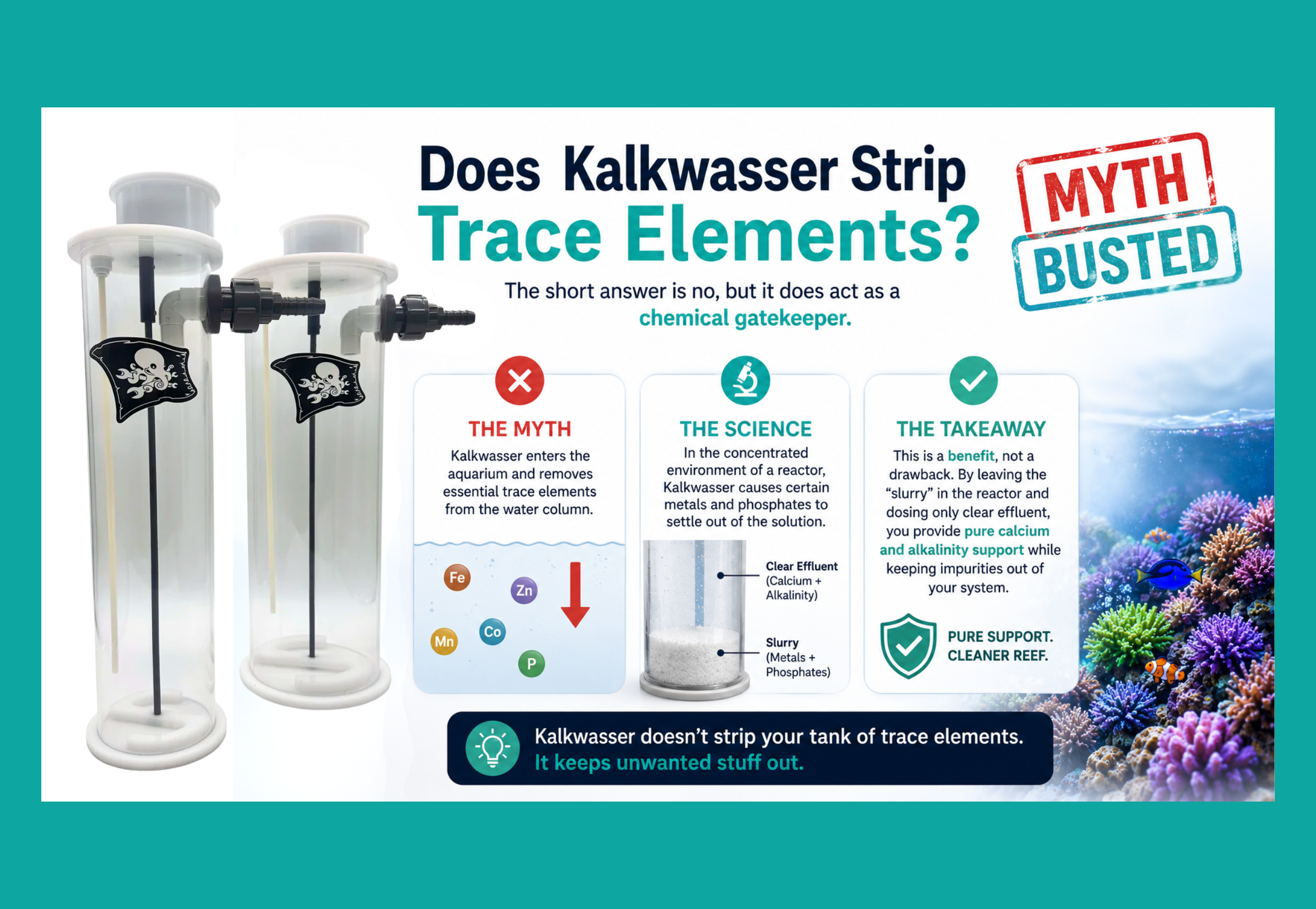
Clear Kalkwasser can be fully saturated. The clear liquid above the settled Kalk is the part we want entering the aquarium. The settled material at the bottom is the working reserve bed. It helps replenish the solution as freshwater moves through the stirrer, but it is not meant to be dosed into the reef. The K1 and K2 are designed around that separation.
Our motor-driven stirrer gently mixes calcium hydroxide 24 hours a day. Undissolved particles stay at the bottom, while clear liquid remains at the top. That design allows the reactor to dose clear Kalkwasser rather than slurry, which we consider the safest way to deliver Kalkwasser to a reef tank.
Slurry dosing carries a different risk profile. Undissolved calcium hydroxide is extremely basic. When solids enter the aquarium, they can create localized zones of very high pH, promoting precipitation. The result can be instability, irritation, or the familiar Kalkwasser “snowstorm.” Clear effluent is controlled. Slurry is not.
The Slurry Is Also a Trap
There is another reason to keep the settled material inside the reactor. At the high pH of limewater, some unwanted materials are less likely to remain dissolved. Holmes-Farley has described limewater as somewhat self-purifying for copper and other metals under the high-calcium, high-hydroxide conditions present in limewater, with particulates such as calcium hydroxide and calcium carbonate helping bind or remove some metals from solution.
That does not mean Kalkwasser eliminates every impurity. It means the settled material can become more than unused Kalk. It may also contain calcium carbonate residue, precipitated impurities, and other material better left behind. This is one of the strongest arguments for dosing clear effluent.
The goal is not to stir everything into a milkshake and send it downstream. The goal is to maintain an active slurry bed at the bottom of the stirrer, allow the solution to saturate, and dose the clear Kalkwasser from above. That is the chemistry behind the mechanical design.
Does Saturated Kalkwasser Stay Effective?
Another common assumption is that Kalkwasser loses strength almost immediately after mixing. The more accurate answer is: it depends on exposure, agitation, and the amount of remaining usable calcium hydroxide.
Kalkwasser reacts with carbon dioxide from the air. That reaction forms calcium carbonate, which no longer contributes the same calcium hydroxide potency. Open, agitated reservoirs lose strength faster than covered, still reservoirs. Time matters, but air contact and mixing behavior matter more.
In a stirrer, the question becomes practical rather than theoretical: how long can the reactor maintain useful output under real operating conditions?
That is why we built the Kalkulator around measured evaporation, make-up percentage, and actual dry Kalk additions for 14-day or 30-day intervals. We also bench-tested output using lab-grade pH equipment. In our testing, pH was more stable when Kalk powder was measured carefully and added every two weeks. Thirty-day additions can still provide benefit, especially with Mississippi Lime, which measured pH 11.75 at day 24 in our tests, but 14-day additions were more consistent.
This is an important distinction. The K1/K2 is not built on the idea that all mixed Kalkwasser instantly fails. It is built on control. Controlled media behavior. Controlled saturation. Controlled clear effluent. Controlled refill intervals. Controlled dosing based on actual evaporation and demand.
Where the K1 and K2 Fit
A Kalk stirrer should not be sized by ego. It should be sized by daily Kalkwasser demand. A lightly stocked large tank may need less Kalkwasser than a smaller reef packed with fast-growing SPS. A dry house may evaporate more than a humid room. A covered aquarium may have less Kalkwasser capacity than an open-top system with fans. Tank size matters, but daily usage matters more.
The K1 can deliver 2.5 gallons of saturated Kalkwasser per day. The K2 can deliver 5 gallons per day. We offer tank ratings from experience, but daily Kalkwasser usage is the deciding factor.
That is why the Kalkulator begins with evaporation. Measure how much water your system actually loses over a few days to a week. Decide what percentage of that evaporation you want to replace with Kalkwasser. Then use that number to determine the correct dry Kalk addition for the refill interval you want to run.
For new Kalk users, we generally recommend starting conservatively and increasing slowly. A tank with low demand does not need to run at the edge. A high-growth SPS system may eventually rely on a very high percentage of evaporation via Kalkwasser. As pH improves and calcification accelerates, demand for calcium and alkalinity may rise.
That is not a flaw in Kalkwasser. That is the carbonate engine responding.
Kalkwasser Reappreciated
Kalkwasser does not need to be reinvented. It needs to be respected. For years, Kalkwasser has been treated as the simple option. In some ways, it is. Calcium hydroxide, freshwater, slow dosing. That simplicity is part of its strength, but simple does not mean unsophisticated.
In a modern reef tank, Kalkwasser can serve as the first layer of a cleaner calcium-and-alkalinity strategy. It supports the carbonate engine, improves pH, reduces the need for heavier two-part dosing, and prevents unnecessary accumulation of sodium chloride. When delivered as clear effluent through a properly designed stirrer, it also keeps the aggressive slurry and potential residue where they belong. Inside the reactor. Not in the reef.
The K1 and K2 exist for that reason. They are not just containers for Kalk. They are controlled-delivery systems built around the details that make Kalkwasser work well: constant, gentle motion; clear, saturated effluent; non-clumping media behavior; easy refills; and sizing based on real daily demand.
That is the reappreciation Kalkwasser deserves. Not as an old-school shortcut. As a disciplined carbonate engine for cleaner reef growth.
In Summary
Kalkwasser remains one of the most useful tools for maintaining a growing reef when it is applied with control.
In a reef tank:
- Calcium and alkalinity consumption reflect real skeletal growth.
- Kalkwasser supports the carbonate engine by adding calcium and alkalinity in a high-pH form.
- pH support is not just a graph improvement. It reflects a more favorable carbonate environment.
- Kalkwasser can reduce reliance on heavy two-part dosing and the sodium-chloride residue that comes with it.
- Clear effluent can be fully saturated and is the part we want entering the aquarium.
- The settled slurry belongs in the reactor, where it serves as reserve media and may help trap unwanted residue.
- Media choice matters. The best Kalk for a stirrer is not only clean; it must hydrate, mix, settle, and remain workable.
- The K1 and K2 are built to deliver Kalkwasser as a controlled system, not a chemistry gamble.
Used correctly, Kalkwasser is not a throwback. It is one of the cleanest ways to support modern reef growth.
PRODUCT PLUG.
If you would like to put Kalkwasser to work on your system, explore the Avast Marine K1 and K2 Kalk Stirrers, Original Recipe Kalkwasser, and Kalkulator. Dose clear. Keep the slurry where it belongs. Let your reef’s carbonate engine run cleaner.
Glossary
Kalkwasser
A saturated solution of calcium hydroxide in fresh RODI water, also known as limewater. It is used to supplement calcium and alkalinity in reef aquariums.
Calcium Hydroxide
The dry compound used to make Kalkwasser. When dissolved in freshwater, it releases calcium and hydroxide ions.
Carbonate Engine
A practical way to describe the linked calcium, alkalinity, pH, and carbon dioxide chemistry that supports calcification in a reef aquarium.
Alkalinity
A measure of the water’s ability to neutralize acid. In reef aquariums, alkalinity is closely tied to the availability of bicarbonate and carbonate for calcification.
Calcification
The biological process by which corals, coralline algae, clams, and other organisms build a calcium carbonate skeleton or shell material.
Clear Effluent
The clear, saturated Kalkwasser is drawn from the upper portion of a Kalk stirrer. This is the liquid intended for dosing into the aquarium.
Slurry
The settled mixture of undissolved calcium hydroxide, calcium carbonate residue, and other solids at the bottom of a Kalk reactor or reservoir. In a K1/K2, the slurry is meant to remain in the reactor.
Saturation
The point at which water has dissolved as much calcium hydroxide as it can under the given conditions. Fully saturated Kalkwasser can still appear clear.
Sodium-Chloride Residue
Sodium and chloride are left behind by many two-part dosing systems after calcium and alkalinity have been consumed. Over time, this can contribute to salinity and ion-balance management.
Make-Up Percentage
The percentage of daily evaporated water replaced with Kalkwasser. This is one of the core inputs in the Avast Kalkulator.
References and Further Reading
The concepts in this article are grounded in reef chemistry, applied Kalkwasser testing, and Avast Marine’s long-term experience designing Kalk stirrers for controlled, clear effluent dosing.
- Avast Marine Works. Original Recipe Kalkwasser.
- Avast Marine Works. K1/K2 Kalk Stirrer product specifications.
- Avast Marine Works. Kalkulator and Kalkwasser testing notes.
- Holmes-Farley, R. Chemistry and the Aquarium: Metals in Limewater.
- Holmes-Farley, R. How a Two-Part Alkalinity and Calcium System Works, and Why it Matters.
- Holmes-Farley, R. A Homemade Two-Part Calcium and Alkalinity Additive System.